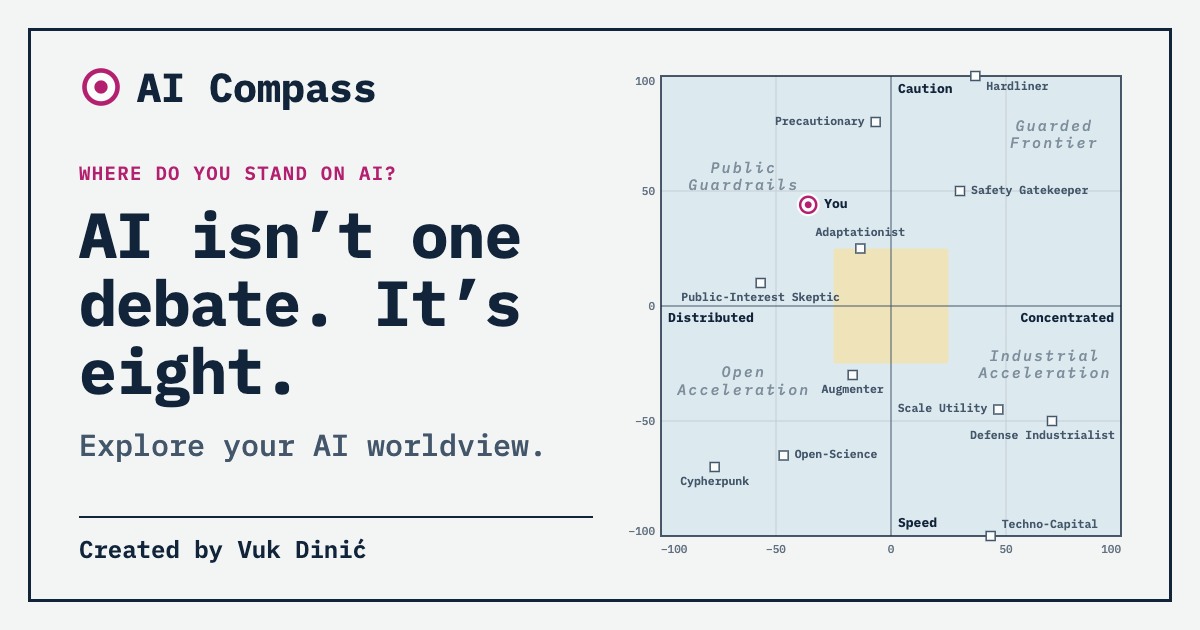
AI isn’t one debate. It’s eight. AI Compass is a free, interactive quiz that asks where you stand on eight separate questions about artificial intelligence, shows your position on each, and lets you compare it with a friend’s.
Open AI Compass → · Source code on GitHub
The problem
Most public talk about AI puts everyone on one line, from optimists to doomers. That line hides more than it shows. Someone can think advanced AI is dangerous and still want it open and widely shared. Someone else can be relaxed about risk and still want strict rules on who profits. Two people who call themselves “cautious” may disagree about almost everything once you ask a second question.
When a disagreement has several dimensions and we talk about it as if it had one, people end up arguing past each other. I wanted something that makes the shape of the disagreement visible.
Why I built it
My work is about how computational methods can help us understand language, politics and public debate. The argument over AI is a good case for that kind of thinking: it is loud, it matters, and its camps are usually described with labels that carry more heat than information.
The starting point was Kristin Houser’s article “10 perspectives that divide the AI world” for Big Think, which sorts the debate into ten tribes. Reading it, I kept noticing that the tribes differed along a smaller number of underlying questions, and that a person could sit with one tribe on one question and with a different tribe on the next. AI Compass is my attempt to pull those questions apart. It is an independent interpretation inspired by that article, not a reproduction of it, and it is not affiliated with its author or with Big Think.
The eight dimensions
Each dimension is one question with two poles and a named middle ground.
| Dimension | The question | From | To |
|---|---|---|---|
| Risk | What are we building, and can something smarter than us be controlled? | Techno-Optimist | AI Doomer |
| Pace | How fast should the most capable AI be built and released, relative to the rules around it? | Effective Accelerationist | Safety-First Advocate |
| Access | Who gets access to the most capable models and the recipes for training them? | Open-Sourcer | Frontier Gatekeeper |
| War | How should AI change military power, deterrence and the use of force? | AI Dove | AI Hawk |
| Labor | Does AI mostly make human workers more capable, or replace thinking work altogether? | Augmentation Optimist | Labor-Disruption Realist |
| Compute | Where does intelligence physically live: on many small devices, or in a few giant data centers? | Distributed and Edge | Centralized Mega-Cluster |
| Architecture | Does general intelligence emerge from scale alone, or does it need new, engineered designs? | World-Model Architect | Scaling Maximalist |
| Wealth | When thinking work no longer needs human time, who owns what it produces? | Compute and Data Redistribution | Capital-Compute Capture |
What it does
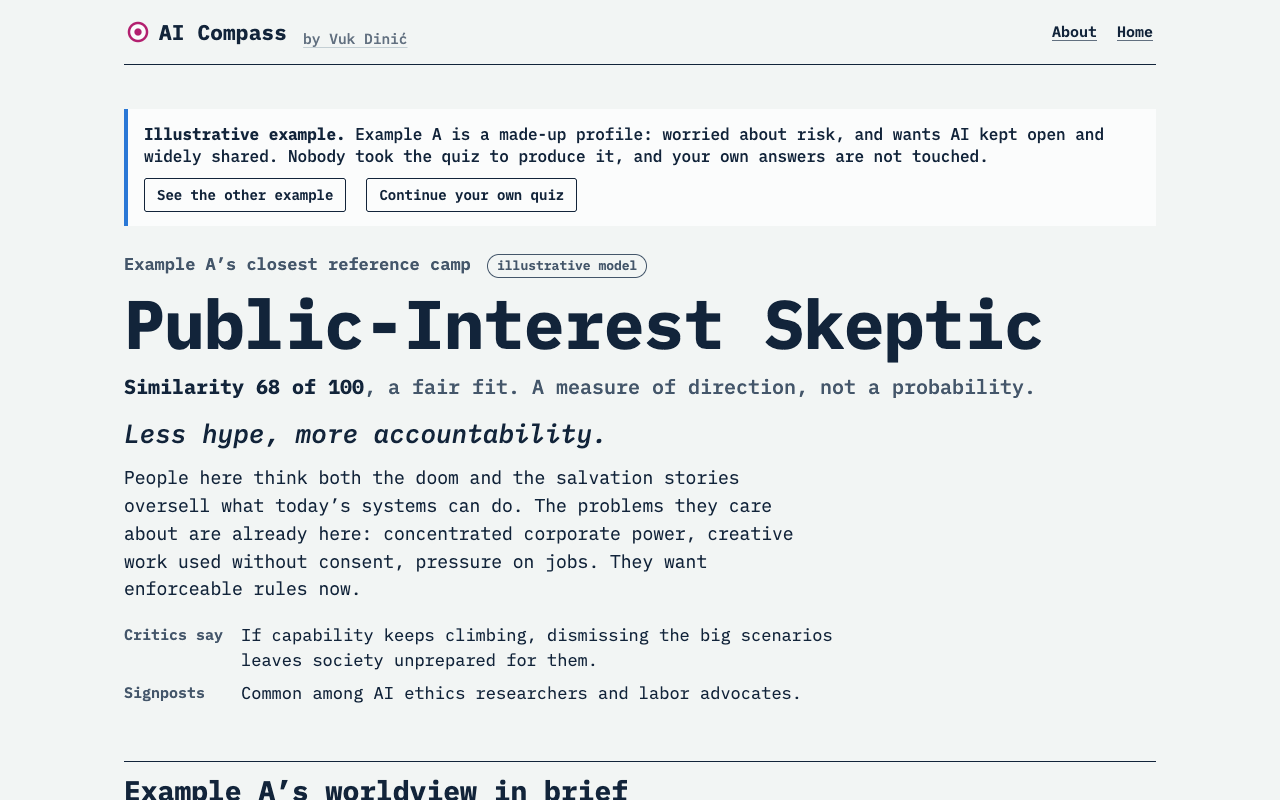
- Two routes. A quick one with 16 statements (about three minutes, a provisional result) and a full one with 48 (about eight minutes). You can continue from the quick route to the full one without losing an answer.
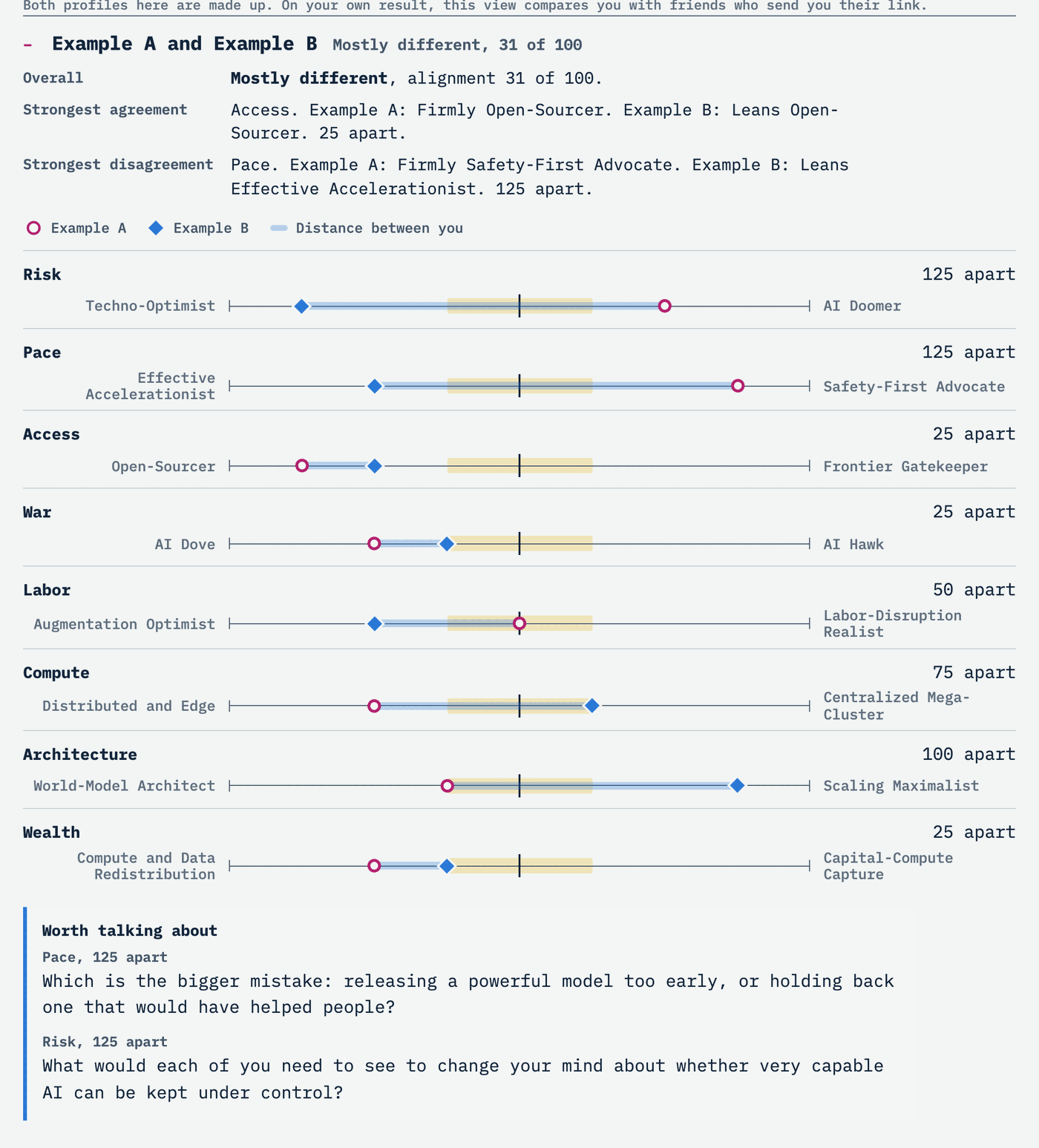
- Eight dimensions first. The result shows your position on every dimension, with both poles, the middle ground, and the answers behind each score.
- A 2D compass. A simplified map that folds five of the eight dimensions into two directions, clearly labelled as a projection.
- A worldview summary. Your firmest position, your most balanced one, and the pairing of views that the fewest reference camps share. It is written by fixed rules, not by a language model, so the same answers always give the same text.
- Reference camps. Eleven illustrative profiles, with the three closest to you and the dimensions where you agree and disagree with each.
- Comparison with friends. Send a link, and see where the two of you agree most, where you differ most, and a couple of questions worth talking over.
- Images to share. A square or portrait picture of your result, drawn in your browser.
- An example mode. Two made-up profiles, clearly labelled, for teaching and presentations.
How it works
Each dimension has six statements, three written from each pole, so agreeing with everything does not push you to either side. You answer on a five-point scale. A dimension’s score is your average agreement with one pole’s statements minus your average agreement with the other’s, on a scale from 100 one way to 100 the other. Statements you skip are left out. They are never counted as neutral.
Similarity to a reference camp is the cosine similarity between your eight scores and the camp’s profile. It measures whether two patterns point the same way, and it is not a probability of belonging to anything. A camp is only named when the similarity is high enough; otherwise the result says so.
The full methodology is on the app’s About page.
What it cannot tell you
AI Compass is an exploratory educational tool, not a scientifically validated psychological or political test.
- The statements were written for this project and have not been tested on a sample of respondents.
- The eight dimensions and the eleven camps reflect my reading of the debate. Someone else would draw them differently.
- The camps are illustrative models. The public figures mentioned beside some of them are rough signposts based on what they have argued in public. None of them took the quiz or endorsed a profile.
- A quick result rests on two statements per dimension and can shift when you answer more.
It is meant to start a conversation, and I would rather it be honest about that than look more precise than it is.
Privacy
There is no account, no analytics and no server that receives your answers. Everything is computed in your browser and stored only there. A share code contains your answers and travels only when you send it yourself.
Technology
- Plain HTML, CSS and JavaScript. No framework, no build step, no backend.
- Hosted as static files on GitHub Pages.
- Charts drawn as SVG, result images drawn on a canvas, both in the browser.
- Pure scoring logic kept separate from the interface and covered by tests (Node’s built-in test runner), plus browser tests in headless Chrome.
Links
- Live app: realvuk.github.io/ai-compass
- Source code: github.com/realvuk/ai-compass
- Essay: AI Isn't One Debate: Why I Built AI Compass
- Feedback: suggest an improvement or report a problem
- Original inspiration: Kristin Houser, “10 perspectives that divide the AI world”, Big Think